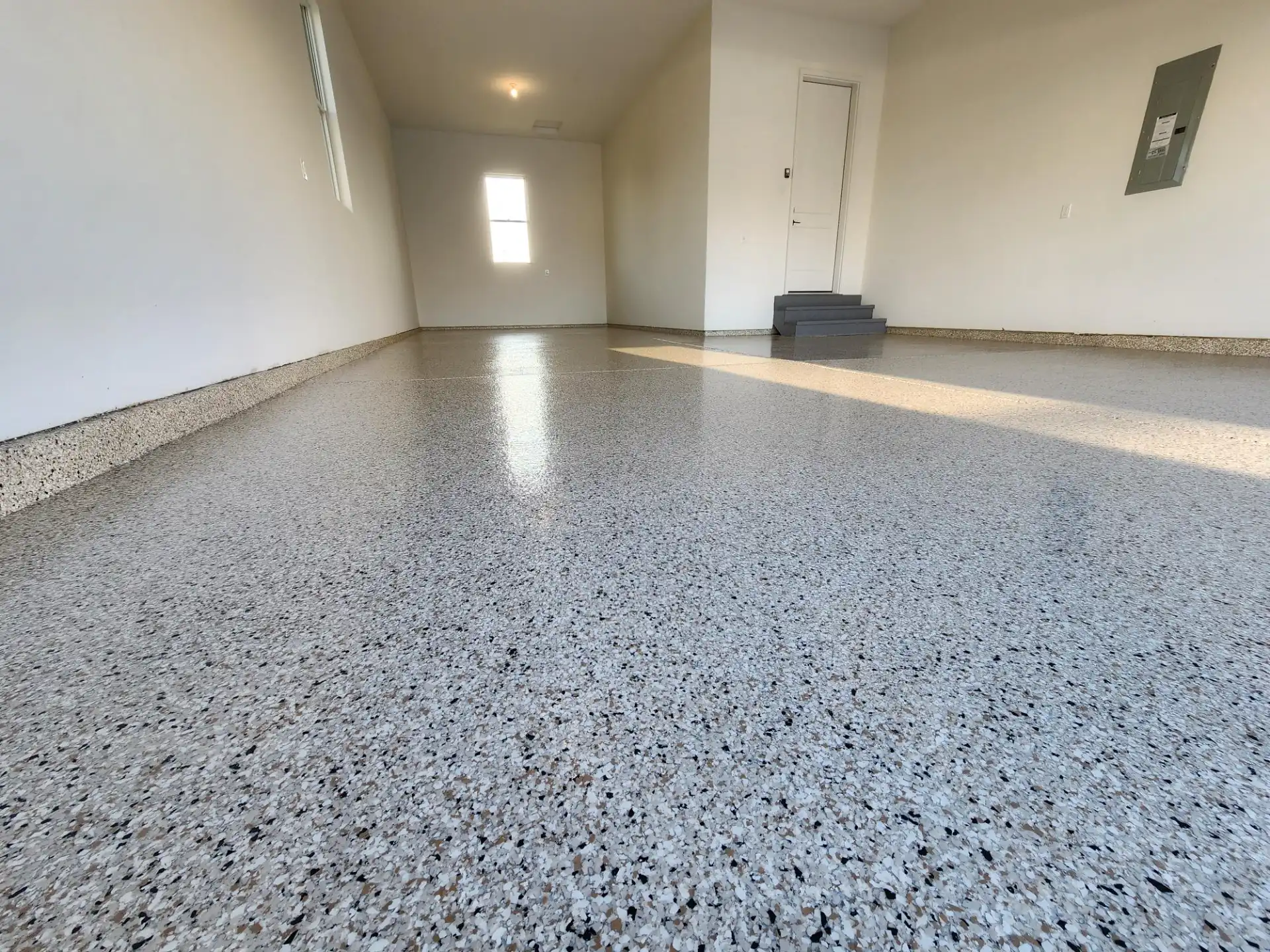
If you are tired of staring at a stained, cracked, dust-covered slab every time you pull into your garage, you are not alone. Garage floor coating has become one of the most popular home upgrades in Indianapolis, Carmel, Fishers, Noblesville, and Zionsville. The right system turns rough concrete into a clean, durable, easy-to-wipe surface that handles hot tires, road salt, oil drips, and Indiana winters for 15 years and beyond.
But not every coating is built the same way, and the differences are bigger than most homeowners realize. The moment you start shopping, you will run into companies promising a one-day install. At Guy Coatings, we take two days on purpose, and this guide explains exactly why that extra day is the difference between a floor that lasts and a floor that fails.
Quick Answer: For Central Indiana garages, the most durable system is a 100% solids epoxy moisture-barrier base coat, cured overnight, with a polyaspartic topcoat applied the next day. The epoxy base penetrates and seals the concrete and blocks moisture coming up from underneath the slab. The polyaspartic topcoat adds UV stability, hardness, and chemical resistance. One-day polyurea-only systems skip the moisture barrier and carry a meaningfully higher failure rate when moisture is present.
The Three Approaches You Will Run Into
Big-box / DIY epoxy. The two-part kits sold at hardware stores are water-based epoxies. They are cheap, but they cure slowly, yellow in sunlight, and peel when the concrete was not prepped correctly. These are the floors that fail within a year or two.
One-day polyurea systems. A lot of companies install a single fast-curing polyurea coating and have you back on the floor the same day. Polyurea is a legitimate, tough product. The problem is what gets skipped to hit a one-day timeline. A polyurea that cures in roughly 14 minutes never actually penetrates into the concrete, because it sets up far too fast to soak in. And there is no dedicated moisture-barrier base underneath it.
The Guy Coatings system. We install a 100% solids epoxy as a moisture-barrier primer first. It penetrates into the slab, bonds, and blocks vapor pressure from below. We let it cure overnight. The next day we apply the polyaspartic topcoat for UV stability, hardness, and a finished look. Two coats, two days, one floor that lasts.
Why the Moisture Barrier Matters More Than Anything Else
Here is the part the one-day companies do not talk about. Every concrete slab transmits moisture vapor upward from the ground. That is normal. The average slab pushes around four pounds of vapor pressure. A polyaspartic topcoat on its own can only hold back about three. Most of the time that is fine. But when there is real moisture, a downspout that backs up, snow melt that pools in a corner, a slab that never fully dries, that vapor lifts the coating off the floor.
A one-day polyurea install will fail roughly 10% of the time for exactly this reason. Our epoxy moisture-barrier base is built to hold back that pressure. When we test a slab and find a moisture problem, we can lay down enough product to hold back up to 20 pounds of pressure. No concrete in Indiana is realistically pushing more than that. If it is, the slab is already crumbling and needs repair, not a coating.
That is the whole reason we will not do the one-day shortcut. We would rather take an extra day than hand you a floor that has a one-in-ten chance of bubbling off.
Head-to-Head Comparison
Here is how the three approaches stack up on the things that actually matter for a Central Indiana garage:
| Feature | Epoxy (big-box / DIY) | One-Day Polyurea | Guy Coatings System |
|---|---|---|---|
| What it is | Water-based hardware-store kit | Single fast-cure polyurea, done in a day | 100% solids epoxy moisture-barrier base + polyaspartic topcoat |
| Penetration into slab | Poor (cures slow, lifts) | Cures too fast to penetrate | Epoxy penetrates and bonds; cured overnight |
| Moisture from underneath | Bubbles, peels | Fails ~10% of the time on moisture | Moisture-barrier epoxy holds back vapor pressure |
| Install time | 1-3 days, needs ideal conditions | 1 day | 2 days (by design, base cures overnight) |
| UV resistance | Poor (yellows) | Topcoat-dependent | Excellent (polyaspartic topcoat) |
| Lifespan | 3-5 years | Varies; higher fail rate on moisture | 15+ years, backed by a 15-year warranty |
Notice the pattern. The one-day timeline is a sales feature, not a performance feature. Every place it saves time, it gives something up underneath the surface.
How Guy Coatings Prepares the Concrete
The coating is only as good as the prep underneath it. Most failed garage floors did not fail because of the product. They failed because the concrete was not prepared correctly. We follow the International Concrete Repair Institute standards on every job.
Diamond grinding. We use industrial diamond grinders to remove the weak, contaminated top layer of concrete and open the pores of the slab. This creates a mechanical bond the coating grips into. Acid etching, the shortcut that comes with most DIY kits, does not produce the same bond.
Crack and chip repair. Every crack, pit, and spalled edge gets filled with a polyurea repair compound that cures harder than the surrounding concrete, then ground flush so the floor reads as one continuous surface.
Moisture testing. We test the slab for moisture before we coat. If we find an issue, we address it with the moisture-barrier system, not after the floor has already bubbled.
Vacuum and tack. Every speck of dust is pulled off the floor with HEPA-filtered vacuums right before the base coat. Dust is the number one contaminant that causes peeling.
Color, Flake, and Finish Options
A modern garage floor does not have to be plain gray. We offer a full range of finishes under the polyaspartic topcoat:
Solid colors. Clean, modern, easy to keep sharp. Great for workshop spaces.
Full broadcast vinyl flake. Multi-color flakes broadcast into the coat and sealed under polyaspartic. Hides minor imperfections, adds slip resistance, and gives that high-end showroom look.
Quartz blends. Natural-looking quartz aggregate, popular for basements and entryways.
Most homeowners pick a flake floor in a neutral blend because it hides salt and dirt between cleanings and pairs with any garage door or trim color.
What Our Two-Day Installation Looks Like
Day one, prep and moisture-barrier base. The crew masks off walls and door frames, diamond-grinds the slab, and repairs every crack and chip. After a full HEPA vacuum, we apply the 100% solid epoxy moisture-barrier base coat to the thickness needed if moisture is present. We broadcast your choice of flake color into the base primer. Then it cures overnight so it can fully penetrate and bond to the concrete.
Day two, flake and polyaspartic topcoat. We scrape and vacuum the excess flake and apply the polyaspartic topcoat that locks everything in and creates the glossy, durable finish. The floor is walk-on ready that evening and drive-on ready after it cures.
Yes, a one-day company would have you back on the floor sooner. But you are trading the moisture barrier and the deep epoxy bond for that convenience. For a floor meant to outlast the vehicles you park on it, the second day is not a delay. It is the reason it lasts.
The 15-Year Warranty, and Why It Actually Means Something
A lot of coating companies hand out a 15-year warranty. What they do not mention is that most of them have only been in business three or four years. A warranty is only as good as the company standing behind it. Guy Coatings has been doing this for 15 years. We have done the warranty work, we know what it takes to make a floor last, and we built our system around products we tested for a full year across jobs in multiple states before we settled on them.
How a Coated Garage Floor Adds Resale Value
A finished garage floor is one of the highest-ROI cosmetic upgrades you can make. Buyers form an impression of a home in seconds, and a glossy, flake-finished floor signals a home that has been maintained. It makes the garage read as usable living space, it photographs well in competitive Carmel, Zionsville, and Fishers listings, and a professionally coated floor under warranty is a done item on the inspection list. Most homeowners recover the investment in resale value while enjoying the floor for years first.
Get a Free Quote
You do not have to commit to anything to find out what your project would cost. Guy Coatings offers free, no-pressure quotes for homeowners across Indianapolis, Carmel, Fishers, Noblesville, and Zionsville. We will measure your space, walk you through color and flake options, test the slab if needed, and give you a flat quote.
Request your free quote at guycoatings.com.
Frequently Asked Questions
Why does Guy Coatings take two days when other companies do it in one?
Because we install a 100% solid epoxy moisture-barrier base that has to cure overnight before the polyaspartic topcoat goes on. That base is what penetrates the slab and blocks moisture from underneath. One-day systems skip it, which is why they fail more often when moisture is present.
How long does the floor last?
With our system and proper prep, a coated floor can last a lifetime. We back it with a 15-year warranty, but that is the guarantee, not the expiration date. Most failures in the industry happen in the first two years and trace back to bad prep or a missing moisture barrier.
Is a one-day polyurea floor a bad product?
Not always. On a brand-new home with perfect grading, slope, and drainage and a dry slab, it may never have a problem. But on slabs with any moisture, older construction, or poor drainage, the failure rate climbs to around 10%. Our system is built to handle the cases where one-day floors fail.
Will the coating peel like a hardware-store kit?
No. The big-box kits are water-based epoxies that rely on acid etching for adhesion and commonly peel within one to three years. Our system bonds mechanically to diamond-ground concrete and is sealed under a polyaspartic topcoat.
Do you serve my city?
Yes. Guy Coatings serves Indianapolis, Carmel, Fishers, Noblesville, Zionsville, Westfield, Geist, and the surrounding Central Indiana communities.