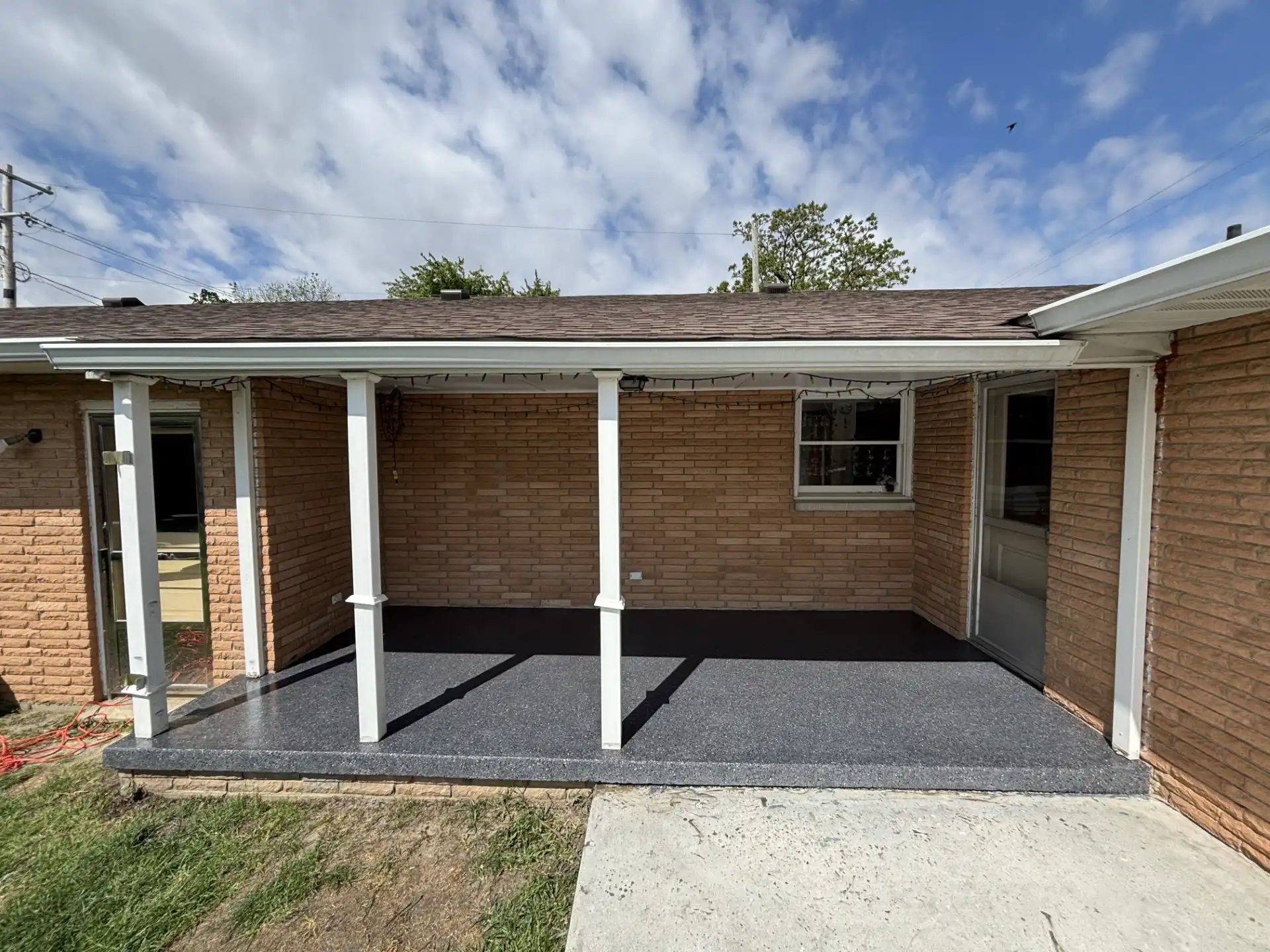
Summer in Indiana is short, and you want to spend as much of it as possible on your patio, not staring at the cracked, faded, stained concrete you keep meaning to fix. A patio concrete coating is the fastest way to turn a tired slab into an outdoor space that looks great, feels great underfoot, and holds up to everything our weather throws at it.
Homeowners in Indianapolis, Carmel, Fishers, Noblesville, and Zionsville are upgrading their patios with a real coating system instead of resealing or repainting every couple of years. The reason is simple. A professionally installed system lasts 15 years and beyond, resists UV damage, seals out the moisture that destroys concrete, and adds real slip resistance for safety around pools and entertaining spaces.
Quick Answer: The most durable patio system for Central Indiana is a penetrating epoxy moisture-barrier base sealed under a UV-stable polyaspartic topcoat. The base blocks water from getting into and under the slab, which is what causes freeze-thaw cracking and spalling. The polyaspartic topcoat resists UV yellowing, chemicals, and abrasion. It outperforms sealers and concrete paint by a wide margin and lasts 15 to 20 years and beyond.
Why Indiana's Freeze-Thaw Cycles Destroy Unprotected Patio Concrete
Concrete looks tough, but it is actually porous. Water seeps into the surface through tiny capillaries, and when temperatures drop below freezing, that water expands by about 9%. That expansion pushes the concrete apart from the inside.
In Central Indiana we get dozens of freeze-thaw cycles every winter, and each one widens existing cracks, creates new ones, and causes the surface to flake off in a process called spalling. Add staining from leaves, mildew, grill grease, pollen, and pool chemicals, and an uncoated patio can go from almost new to needing replacement in just a few years.
A properly installed system seals the concrete and blocks water entry. The penetrating epoxy base is the key. It soaks into the slab and forms a moisture barrier, so water cannot get in from above or push up from below. No water means no freeze damage, no spalling, no widening cracks, and no expensive replacement.
How a Real Coating System Outperforms Sealers and Paint
Most homeowners have tried one of three approaches before they call us:
Concrete sealer
Sealers soak in and provide a thin layer of water resistance. They are cheap, but they wear off in one to three years and offer no real impact, abrasion, or stain resistance. You are signing up for annual reapplication.
Concrete paint or stain
Paints and stains add color but sit on top of the concrete with weak adhesion. They peel, fade, and need to be stripped and redone within a couple of seasons. UV exposure speeds up the failure.
A penetrating epoxy base with a polyaspartic topcoat
This is an industrial-grade system. The base is a 100% solid, slow-cure, moisture-vapor-barrier epoxy that penetrates and bonds into the prepped concrete and seals moisture out from below. The polyaspartic topcoat is a UV-stable, hard, chemical-resistant finish. Instead of sitting on the surface, the system grips into it and lasts 15 to 20 years and beyond.
For how this same system works on a garage, see our garage floor coating page.
The cost difference between a quality system and yet another reseal job evens out fast. Most homeowners in Central Indiana break even by year four and pull ahead every year after.
UV Stability: Why It Matters for Indiana Patios
Indiana summer sun is no joke. Patios take direct UV for six or more hours a day from May through September, and most coatings cannot handle it.
What happens to coatings that are not UV-stable
Standard epoxy and many cheap outdoor coatings yellow within 12 to 18 months of UV exposure. A clean gray or slate color turns into a dingy, blotchy yellow-brown, and once it yellows there is no going back. You are stripping and recoating.
Why the polyaspartic topcoat stays true
Polyaspartic was engineered for UV stability. The chemistry resists the photochemical reactions that cause yellowing. A patio finished with a polyaspartic topcoat today will look essentially identical 10 years from now. For homeowners in Carmel, Zionsville, and Fishers who invest in beautiful outdoor living spaces, that matters. Your patio should not look worse than your furniture by year two.
Slip Resistance for Pool Decks, Patios, and Walkways
Smooth, glossy floors look great in a garage. On a wet pool deck they are a liability. Coated patios should always be specced with the right level of slip resistance for the application.
- Aluminum oxide additive. A fine grit broadcast into the topcoat that adds noticeable grip without making the surface uncomfortable. Ideal for pool decks and patios that get rained on.
- Vinyl flake. Multi-colored flakes broadcast into the base. They add slight texture, hide imperfections, and look great.
- Quartz aggregate. Larger, more visible texture for high-traffic outdoor entrances and walkways. Provides the most aggressive grip.
- Smooth finish. For covered patios where slip risk is low and you want maximum gloss and easy cleaning.
We talk through every customer's actual usage, kids, pets, pool, hot tub, grill area, and match the texture level to real-world needs. Too much grip can make the surface hard to sweep. Too little is unsafe when wet.
Color and Finish Choices That Complement Your Home
A patio coating is not just protection. It is a design element. The best results come from picking a color and finish that work with your home's exterior, landscaping, and outdoor furniture.
- Earth tones. Tans, browns, and terra cotta that work with brick, stone, and traditional Indiana exteriors.
- Cool grays and slate. Modern, clean, and versatile. Pair well with white trim and contemporary landscaping common in newer Carmel and Westfield neighborhoods.
- Stone-look quartz blends. Mimic the look of natural stone at a fraction of the cost. Great for upscale entertaining areas.
- Custom color matching. We can match almost any color from a paint sample or photo.
Sheen options run from satin (low-glare, natural outdoors) to semi-gloss to high-gloss for shaded patios and screened porches where glare is not an issue.
Maintenance Tips for Coated Outdoor Concrete
- Routine cleaning. Sweep regularly, rinse with a garden hose as needed, and for deeper cleaning use a soft-bristle brush with mild soap and water. Avoid harsh solvents, which can dull the finish over time.
- Winter care. You can use ice melt on coated surfaces, but stick to magnesium chloride or calcium chloride and avoid high-sodium rock salt. Shovel with a plastic-edged shovel, not a metal scraper.
- Furniture and grills. Use felt pads or rubber feet on heavy furniture to prevent point-load damage, and put a mat under your grill to catch grease drips.
- Annual inspection. Walk the patio every spring and look for small chips or scratches. Minor touch-ups with the original material extend the lifespan.
What a Guy Coatings Patio Transformation Looks Like
Before. Cracked surface with visible spalling, dark stains from leaves and grill grease, faded color, and pitting around the edges. The patio looks tired and drags down the whole backyard.
Install, day one. We diamond-grind the entire surface to remove the weak top layer and open the pores for bonding. Cracks and pits get filled with polyurea repair compounds. The slab gets vacuumed and tacked clean, then we apply the penetrating epoxy moisture-barrier base and let it cure.
Install, day two. The vinyl flake or aggregate is broadcast into the base coat on day one. On day two we scrape and vacuum the excess and apply the UV-stable polyaspartic topcoat. The result is a continuous, slip-resistant surface with rich color depth and a finish you would expect at a high-end resort. The cracks are gone, visually and structurally, the stains are sealed away, and the patio feels like an extension of the home.
We take the time to do the base and topcoat as separate cured layers because that is what makes the finish last through Indiana winters instead of lifting after a season or two.
Get a Free Patio Quote
You do not have to guess what your patio could become. Guy Coatings offers free, no-pressure quotes for homeowners across Indianapolis, Carmel, Fishers, Noblesville, and Zionsville. We will inspect your slab, talk through color and slip-resistance options, and give you a flat quote. Most projects can be scheduled within two to three weeks, well in time for peak summer.
Request your free patio quote at guycoatings.com.
Frequently Asked Questions
How long does a coated patio last in Indiana?
With proper prep and a polyaspartic topcoat over a moisture-barrier base, 15 to 20 years and beyond. UV stability and freeze-thaw resistance are built into the system, which is why we recommend it over sealers and paints for outdoor use.
Will the coating get too hot to walk on in summer?
Lighter colors stay noticeably cooler than dark colors. We always discuss color choice with pool deck and barefoot-area customers to make sure the finish is comfortable underfoot.
Can you coat a patio that already has cracks?
Yes. We fill all cracks, chips, and pitting with polyurea repair compounds during prep. Active structural cracks may need additional evaluation, but most cosmetic and freeze-related cracks are repaired and sealed as part of the standard process.
Is the coating safe around pool chemicals?
Yes. The polyaspartic topcoat resists chlorine, salt, and standard pool chemicals. It is a popular choice for pool decks in Carmel, Zionsville, and Geist for that reason.
Do you serve my city?
Yes. Guy Coatings serves Indianapolis, Carmel, Fishers, Noblesville, Zionsville, Westfield, Geist, and the surrounding Central Indiana communities.